Franklin College

Policies, Procedures & Disclosures

Policy on Non-Discrimination

Franklin College is committed to the principle and practice of equal opportunity for all its students, faculty, employees and applicants for admission and employment. For that reason, the college provides equal employment opportunities to all of its employees and applicants on the basis of merit and without regard to the individual’s race, color, religion, gender, disability, age, national origin, marital status, or sexual orientation in accordance with state and federal laws and any other characteristic protected by law.

The college prohibits, forbids, and will not tolerate any verbal, physical or other conduct that belittles or demeans any individual on the basis of the above-listed statuses. All employees, managers, supervisors and job applicants are covered by this commitment.

No person or employee, no matter what his or her title or position, has the authority expressed, actual, apparent or implied to discriminate against any employee of the college.

This policy applies to all terms and conditions of employment, admission to and enrollment in Franklin College, including, but not limited to, recruitment, selection, hiring, benefits, educational policies, admission policies, financial aid, scholarship and loan programs, housing athletic and other college-administered programs and activities.

If you have any questions, problems, or complaints regarding a violation of this Policy on Non-discrimination or discrimination in general or Title IX, you may seek assistance from the Title IX coordinator.

Steve Leonard photographSteve Leonard
Title IX Officer
317.738.8899
TitleIXresponse@FranklinCollege.edu

Policies, Procedures and Disclosures

Student Complaint Policy and Procedures

Franklin College Student Complaint Policy and Procedures

The College has an obligation to provide an avenue for students to share concerns, to identify problems, and to appropriately address areas of concern. Federal regulations and accreditation agencies require policies specific to a variety of concerns. Additionally, the College must track significant concerns and monitor the quality of our services.

Franklin College strives to address student concerns in a prompt and responsive manner. The purpose of this policy is to outline the processes by which Franklin College students can register concerns and complaints and seek redress. Students have multiple ways to express concerns either informally or formally as indicated below. This document also provides a process for reporting and tracking concerns that are not addressed by or remain unresolved after exhausting other existing procedures.

Initial Steps to Resolve Concerns

  1. Members of the Franklin College community are first encouraged to address difficulties and resolve conflicts that arise directly with the parties involved.
  2. The next step for resolving a concern is generally to approach the supervisor responsible for the area related to the concern.
  3. Should this prove unsatisfactory or inappropriate for resolving a specific concern, a student may file a formal complaint as outlined later in this document.

Most student concerns are governed by one of the college’s established procedures. Before filing a formal complaint, a student is expected to seek resolution through the channels as explained in the following section.

Established Policies and Procedures for Addressing Student Concerns

Information can be found in several different locations regarding the policies and procedures in each of the following areas:

Academic Records & Privacy

See the academic policies section of the college catalog for the full FERPA policy.

Academic Integrity

There are specific procedures for students who wish to dispute an academic decision which can be found in the academic policies section of the college catalog.

Admissions

Every student has the right to one appeal of an admission decision. You may do so through your admissions counselor or by contacting the Office of Admission at 1.888.852.6471; admissions@FranklinCollege.edu.

Athletics

See the Student-Athlete Handbook for more information on the grievance policy in Athletics at Franklin College.

Bias, Harassment, Sexual Misconduct

Bias, harassment and sexual misconduct are addressed through the procedures found on the student life tab of the college webpage here.

Disability Services

A student with disability should first contact the assistant dean for academic services when accommodation-related concerns arise. More information on the formal complaint process is also available on the disability services web page, or by calling or emailing the Academic Resource Center at 317.738.8288; arc@FranklinCollege.edu.

Residence Life

Concerns related to various aspects of Residence Life can be submitted by email (residencelife@FranklinCollege.edu) or by phone at 317.738.8080. The concern will be routed to the appropriate parties for response.

Financial Aid

Prospective and current students have a right to request a review of a financial aid decision. To request such a review, contact the office of financial aid at 317.738.8075 or by email at finaid@FranklinCollege.edu.

Student Conduct and Campus Life

https://franklincollege.edu/wp-content/uploads/2024/10/PDF-Procedures-for-Reporting-and-Responding-to-Complaints-of-Violations-of-the-Student-Code-of-Conduct-Involving-a-Student-as-a-Responding-Party-2.pdf

Tuition, Fees & Student Accounts

Complaints and concerns about handling and decisions about tuition, fees, and student accounts should be communicated to the Business Office at 317.738-8031.

Student Formal Complaint Process

The formal complaint process governs concerns that are either (1) not addressed by or (2) not resolved through any of the established policies described in the previous section. A student who feels that he or she has been treated unfairly or unjustly by any employee has the right to file a formal complaint. Complaints may be submitted by a student currently enrolled, a person enrolled in the previous academic year, an alumnus who earned a degree from the institution in the past 12 months. Complaints may be filed up to 120 days from the date of the incident. Complaints may not be filed anonymously and may not be submitted by a parent, relative, employer or the public, etc. (even if related to a student).

For a complaint to be considered it must:

  • Be signed by the student submitting the complaint
  • Be submitted in writing
  • Include nature of the complaint and college department/employee involved
  • Outline the steps taken previously to resolve the complaint
  • Express the desired resolution
  • Be delivered via email to StudentComplaints@FranklinCollege.edu

Complaints received at this email address will be reviewed by the Vice President for Student Affairs who will assess whether the reported concern conforms to the criteria for a formal complaint outlined above. If it is determined to constitute a complaint, the complainant will be informed of that. The complaint will then be forwarded to the college official(s) best positioned to handle the concern. The official(s) will consider the complaint and respond in writing to the student generally within 30 calendar days of the submission of the complaint with recommended appropriate resolution. The Vice President for Student Affairs will keep a record of student complaints.

Institutional Record of Student Complaints

Complaint information that is tracked:

  • Date complaint received
  • Student(s) identified in complaint
  • Nature of the complaint
  • Steps taken to resolve the complaint
  • Final decision or action taken by college
  • Any external contact initiated by the student

Franklin College will maintain and annually review this record of student complaints. Giving attention to patterns of complaints will allow for improvement in college operations. This review will consider:

  • Total number of complaints received
  • Types of complaints received by generic category
  • Total number of complaints referred to external agency for final resolution
  • Summary of complaints, actions taken, external referrals make

Complaints to External Agencies

Student complaints not resolved through the College’s formal complaint process outlined here may be reported to an external agency, including the Higher Learning Commission, The Office of Civil Rights and the Indiana Commission on Higher Education. We recommend that students refer to the specific agency’s policies and requirements for filing as many agencies require students to first exhaust their college’s grievance procedures.

Higher Learning Commission
230 South LaSalle Street, Suite 7-500
Chicago, IL 60604
800.621.7440
https://www.hlcommission.org/for-students/file-a-complaint-against-an-institution/

Indiana Commission on Higher Education
101 West Ohio Street, Suite 300
Indianapolis, IN 46204-4206
317.464.4400
888.528.4719

https://www.in.gov/che/2744.htm

US Department of Education
National Headquarters
U.S. Department of Education – Office for Civil Rights
Lyndon Baines Johnson Department of Education Bldg
400 Maryland Avenue, SW
Washington, DC 20202-1100
800.421.3481
Email: OCR@ed.gov

Chicago Office (oversight for Indiana)
Office for Civil rights – US Department of Education
Citigroup Center
500 W. Madison Street, Suite 1475
Chicago, IL 60661-4544
Telephone: 312.730.1560
Email: OCR.Chicago@ed.gov

US Dept. of Education
Family Policy Compliance Office
400 Maryland Ave., S.W.
Washington, DC 20202
https://studentprivacy.ed.gov/file-a-complaint

Non-Retaliation Statement

Retaliation, or attempts to retaliate, against any individual who files a grievance or complaint is strictly prohibited.

Important Policies and Misconduct Information

Franklin College Values YOU

Franklin College upholds a common set of values that enhances the community and sustains personal, spiritual, intellectual and professional growth for a lifetime. Our values encompass standards of behavior that reflect integrity, ethical conduct and speech. We embrace all forms of diversity and value empathy, sincerity and openness in the way we treat one another. Our community is an environment that is responsive to the needs of others. As such, discrimination, harassment, and sexual or other misconduct are not tolerated on our campus.

We believe that a culture of care is one in which honesty, responsibility, diversity, dignity, and respect are valued and practiced. As members of the Franklin College community, we commit ourselves to ensure that our actions match our values. If you experience or witness treatment that violates these principles, the following support and reporting options are available to you.

Report

Please call 911 to report an emergency. In non-emergency situations, members of the campus community can report discrimination, harassment or sexual misconduct here:

REPORT HERE

If you are not a current member of the campus community, contact the college’s Title IX Coordinator to report.

Title IX Coordinator – Steve Leonard 317.738.8899 or TitleIXresponse@FranklinCollege.edu

All submitted reports are reviewed by the Title IX Coordinator.

Protection of Minors

Policy on the Protection of Minors (PDF)

Support

Franklin College provides support to anyone who encounters misconduct as outlined in policies and procedures be found below. See below for reference to a range of contacts for support and assistance in addressing an instance of discrimination, harassment or related misconduct. Additionally, the Response Team can connect you with needed supports.

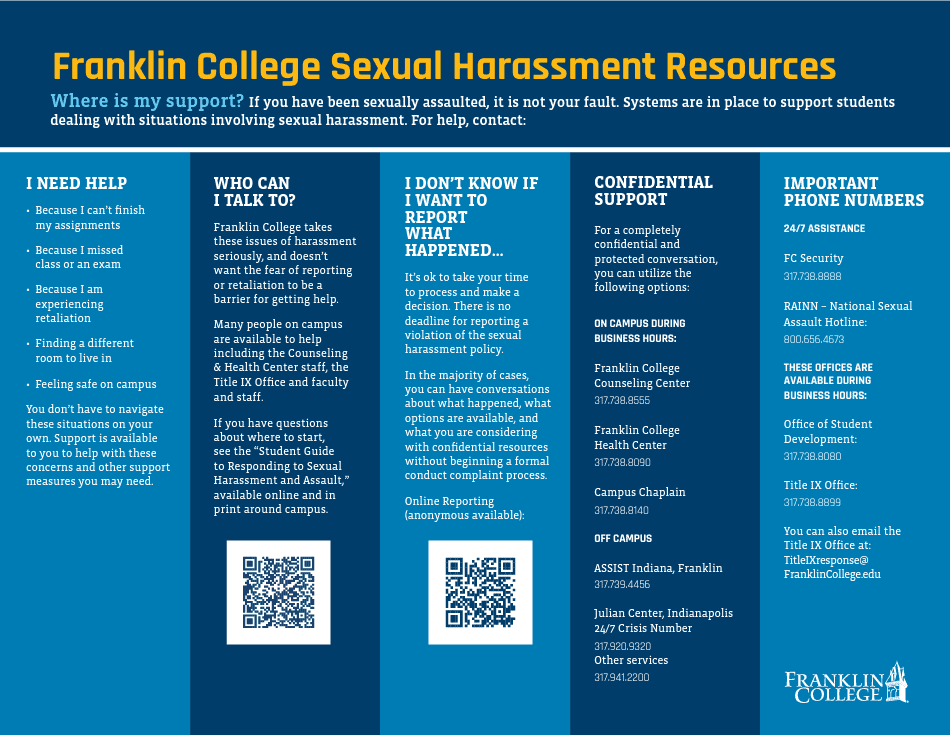
Sexual Harassment Resources (PDF)

Procedures for Reporting and Responding to Complaints of Discrimination, Harassment, Misconduct, and Hazing Involving a Student, Student Organization or Employee as the Respondent (PDF)

Resources for Victims of Sexual Assault (PDF)

Privacy and Legal

Franklin College Privacy Policy

This privacy policy has been provided to better serve those who are concerned with how their ‘Personally identifiable information’ (PII) is being used online. PII, as used in US privacy law and information security, is information that can be used on its own or with other information to identify, contact, or locate a single person, or to identify an individual in context. Please read our privacy policy carefully to get a clear understanding of how we collect, use, protect or otherwise handle your PII in accordance with our website.

What personal information do we collect from people who visit our website?

To help with your experience on the Franklin College website, you may be asked to enter your name, email address, mailing address, phone number, credit card information or other details.

When do we collect information?

We collect data when you request information, register for an event or fill out a form on our site.

How do we use your information?

We may use the information we collect from you to quickly process transactions and/or to send periodic emails regarding your order, events or other products and services.

How do we protect visitor information?

Our website is scanned regularly for security vulnerabilities to make your visit as safe as possible.

Your PII is contained within secured networks and is only accessible by a limited number of persons with special access rights, who are required to maintain confidentiality. In addition, all sensitive/credit information you supply is encrypted via Secure Socket Layer (SSL) technology. All transactions are processed through a gateway provider and are not stored or processed on our servers.

Do we use ‘cookies’?

We use cookies for tracking purposes.

You can choose to be notified each time a cookie is being sent, or turn off all cookies through your browser (Chrome, Safari or Edge) settings. Refer to your browser’s Help menu to learn the correct way to modify your cookie settings.

If you disable cookies, some features will be disabled that would make your site experience more efficient, and some services may not function as designed.

Third Party Disclosure

We do not sell, trade, or otherwise transfer your PII to outside parties.

Third Party links

We do not include or offer third party products or services on our website.

Google

Google’s advertising requirements can be summed up by Google’s Advertising Principles. They are put in place to provide a positive experience for users. https://support.google.com/adwordspolicy/answer/1316548?hl=en

We use Google AdSense Advertising on our website.

Google, as a third party vendor, uses cookies to serve ads on our site. Google’s use of the DART cookie enables it to serve ads to our users based on their visit to our site and other sites on the Internet. Users may opt out of the use of the DART cookie by visiting the Google ad and content network privacy policy.

We Have Implemented Demographics and Interests Reporting

We along with third-party vendors, such as Google use first-party cookies (such as the Google Analytics cookies) and third-party cookies (such as the DoubleClick cookie) or other third-party identifiers together

We use site metrics to understand our audience.

Opting out:

Users can set preferences for how Google advertises to you using the Google Ad Settings page. Alternatively, you can opt out by visiting the Network Advertising initiative opt out page or permanently using the Google Analytics Opt Out Browser add on.

California Online Privacy Protection Act

CalOPPA is the first state law in the nation to require commercial websites and online services to post a privacy policy. The law’s reach stretches well beyond California to require a person or company in the United States (and conceivably the world) that operates websites collecting personally identifiable information from California consumers to post a conspicuous privacy policy on its website stating exactly the information being collected and those individuals with whom it is being shared, and to comply with this policy. – See more at: http://consumercal.org/california-online-privacy-protection-act-caloppa/#sthash.0FdRbT51.dpuf

How does our site handle do not track signals?

We honor do not track signals and do not track, plant cookies or use advertising when a Do Not Track (DNT) browser mechanism is in place.

Does our site allow third party behavioral tracking?

It’s also important to note that we do not allow third party behavioral tracking.

COPPA (Children Online Privacy Protection Act)

When it comes to the collection of personal information from children under 13, the Children’s Online Privacy Protection Act (COPPA) puts parents in control. The Federal Trade Commission, the nation’s consumer protection agency, enforces the COPPA Rule, which spells out what operators of websites and online services must do to protect children’s privacy and safety online.

We do not specifically market to children under 13 nor do we knowingly collect or retain personal information from, children who are younger than 13 years of age. If we discover that we have inadvertently collected information from a child under 13 years of age, we will promptly take all reasonable measures to delete such information from our systems.

Fair Information Practices

The Fair Information Practices Principles form the backbone of privacy law in the United States and the concepts they include have played a significant role in the development of data protection laws around the globe. Understanding the Fair Information Practice Principles and how they should be implemented is critical to comply with the various privacy laws that protect personal information.

In order to be in line with Fair Information Practices we will take the following responsive action, should a data breach occur:

We will notify the users via in site notification within 7 business days.

We also agree to the individual redress principle, which requires that individuals have a right to pursue legally enforceable rights against data collectors and processors who fail to adhere to the law. This principle requires not only that individuals have enforceable rights against data users, but also that individuals have recourse to courts or a government agency to investigate and/or prosecute non-compliance by data processors.

CAN SPAM Act

The CAN-SPAM Act is a law that sets the rules for commercial email, establishes requirements for commercial messages, gives recipients the right to have emails stopped from being sent to them, and spells out tough penalties for violations.

We collect your email address in order to:

      Send information, respond to inquiries, and/or other requests or questions.

      Market to our mailing list or continue to send emails to our clients after the original transaction has occurred

To be in accordance with CANSPAM we agree to the following:

      Not use false, or misleading subjects or email addresses

      Identify the message as an advertisement in some reasonable way

      Include the physical address of our business or site headquarters

      Monitor third party email marketing services for compliance, if one is used.

      Honor opt-out/unsubscribe requests quickly

      Allow users to unsubscribe by using the link at the bottom of each email

If at any time you would like to unsubscribe from receiving future emails, you can:

Follow the instructions at the bottom of each email and we will promptly remove you from all correspondence.

Contacting Us

If there are any questions regarding this privacy policy, you may contact us using the information below.

Toll free phone number: 800.852.0232
Email: webadministrator@FranklinCollege.edu

101 Branigin Blvd
Franklin, IN 46131 USA

Last Edited on 2024-1-3

Title IX at Franklin College

Title IX Policy

Student Guide to Responding to Sexual Assault and Harassment (PDF)

Sexual Assault Resources for Support (PDF)

Pursuant to Title IX, Franklin College prohibits gender discrimination in all programs and activities of the college and requires that the college be proactive in preventing discrimination and in responding to concerns or allegations of discrimination. Title IX applies to all programs and activities available to students at Franklin College. These include but are not limited to athletic programs, academic programs, admission procedures, financial aid, career services, counseling and health services. Although Franklin College’s policies and procedures relating to Title IX are founded on the laws of the United States and the state of Indiana, they are also guided by the mission and values of the college.

The goal of Title IX is to ensure equal opportunity and gender equity for all members of the campus community. The Title IX Officer is responsible for the Colleges compliance with Title IX of the Education Amendments of 1972. The Title IX Officer will monitor and oversee implementation of Title IX Compliance at the College, including coordination of training, education, communications, and administration of reporting procedures for faculty and staff.

Non-Discrimination

Non-Discrimination Policy (PDF)
Policy on Prohibited Discrimination, Harassment and Related Misconduct (PDF)

Who We Are

Steve Leonard photograph

Steve Leonard
Director of Security; Title IX Coordinator
317.738.8316
sleonard@FranklinCollege.edu
TitleIXResponse@FranklinCollege.edu


Shelli York photographShelli York
Director of Human Resources; Deputy Title IX Coordinator
317.738.8028
syork@FranklinCollege.edu
TitleIXResponse@FranklinCollege.edu

Hazing Policy

Franklin College Hazing Policy

Hazing is defined as an act that, as an explicit or implicit condition for initiation to, admission into, affiliation with, or continued membership in a group or organization could be seen by a reasonable person as endangering the physical health of an individual or as causing mental distress to an individual through, for example, humiliating, intimidating, or demeaning treatment; destroys or removes public or private property; involves the consumption of alcohol, other drugs, or other substances; or violates any of the policies of Franklin College. It is not a defense to an allegation of hazing that the expressed or implied consent of an individual was obtained. In addition to this policy, NCAA student-athletes must follow the hazing policies and guidelines set forth by the NCAA, HCAC, and Franklin College athletics department. When allegations of violations of this policy are received, the group or organization, as well as an individual, will be subject to adjudication.

To report a hazing policy violation, submit a report form on GrizLink. If you are not a student, faculty or staff member, you can email hazingreports@franklincollege.edu to make a report. The reporting form is not intended for in-progress incidents. If you are currently witnessing a crime or concerning situation, please call Campus Security at 317-738-8888 or 911.

The process used to investigate and, if found responsible, adjudicate incidents of hazing can be found here.

Indiana Anti-Hazing Law

IC 35-42-2-2.5 Hazing; good faith reporting

(a) As used in this section, “hazing” means forcing or requiring another person:

(1) with or without the consent of the other person; and

(2) as a condition of association with a group or organization; to perform an act that creates a substantial risk of bodily injury.

(b) A person who knowingly or intentionally performs hazing commits a Class B misdemeanor. However, the offense is a Level 6 felony if it results in serious bodily injury to another person, and a Level 5 felony if it is committed by means of a deadly weapon.

(c) A person, other than a person who has committed an offense under this section or a delinquent act that would be an offense under this section if the violator were an adult, who:

(1) makes a report of hazing in good faith;

(2) participates in good faith in a judicial proceeding resulting from a report of hazing;

(3) employs a reporting or participating person described in subdivision (1) or (2); or

(4) supervises a reporting or participating person described in subdivision (1) or (2);

is not liable for civil damages or criminal penalties that might otherwise be imposed because of the report or participation.

(d) A person described in subsection (c)(1) or (c)(2) is presumed to act in good faith.

(e) A person described in subsection (c)(1) or (c)(2) may not be treated as acting in bad faith solely because the person did not have probable cause to believe that a person committed:

(1) an offense under this section; or

(2) a delinquent act that would be an offense under this section if the offender were an adult.

Amnesty Policy and Indiana Lifeline Law

Franklin College strives to maintain a balance between student support and accountability. The College believes in addressing student health and safety concerns directly, and confronting dangerous behaviors, but also encouraging students to seek help in situations where their own, or another student’s health is endangered. As such, a student who seeks assistance on behalf of themselves or another individual experiencing an alcohol and/or drug related incident, may not be subject to conduct action for the alcohol and/or drug use under the Code of Conduct if the Office of Student Development becomes aware of the alcohol and/or drug use solely because the individual(s) sought medical attention. Students who participate in student conduct investigations may also be eligible for Student Conduct Amnesty at the discretion of the vice president for student development or designee. Student(s) involved in reported incidents of sexual misconduct and hazing may receive student conduct amnesty for the alcohol and/or drug violation(s) only. Student Conduct Amnesty is only granted to individual students, not student groups and/or student organizations.

Franklin College Hazing Prevention and Awareness Programming Statement of Policy

Franklin College is committed to fostering a safe, inclusive, and respectful environment for all students, staff, and faculty. Hazing, in any form, is strictly prohibited and goes against the core values of the institution. This policy outlines the College’s efforts to prevent hazing and raise awareness through campus-wide education, primary prevention strategies, and the promotion of ethical leadership.

Students, staff, and faculty will have access to regular workshops that focus on recognizing and addressing the harmful impacts of hazing, with particular attention to ethical leadership, bystander intervention, and personal responsibility within group settings to promote building group cohesion without hazing.

Franklin College will seek to train its students, faculty and staff on hazing prevention and awareness in various ways. First-year students will receive training during Welcome Week to help them understand what hazing is, how to identify it, bystander intervention strategies, and how to report incidents of hazing. Student organizations, including Greek Lettered organizations, will receive yearly training on ethical leadership, building group cohesion without hazing, and bystander intervention. Student athletes will receive yearly hazing prevention and awareness training as it relates to athletics and team dynamics. Franklin College will also offer bi-annual hazing prevention and awareness trainings open to all students, faculty, and staff in September and March to discuss hazing prevention and awareness.

Campus Hazing Transparency Report

2026-2027 Academic Year

No hazing violations have been found for the 2026-2027 academic year at Franklin College.

2025-2026 Academic Year

Organization: Sigma Alpha Epsilon
Date of Incident(s): Fall 2024
Date of College Notification: August 24, 2025
Date(s) of Investigation: August 25-29, 2025
Date of Finding: August 29, 2025
Date of Organization Notification: September 2, 2025
Description of Incident(s):
– New members were coerced into participating in inappropriate activities at the SAE property, some involving alcohol consumption.
Sanction(s):
– Chapter is on organizational probation until August 31, 2026.
– Chapter is required to complete Membership Review, Hazing Awareness Training, and Bystander Intervention Training facilitated by Sigma Alpha Epsilon Fraternity Service Center before any recruitment events may occur.
– Chapter is required to have a chapter advisor or member of the Fraternity Service Center present at all recruitment events in Fall 2025 and new member education events in Fall 2025 and Spring 2026.
– Chapter leadership is required to participate in monthly meetings with Student Development staff for the 2025-2026 academic year to ensure compliance with sanctions.

2024-2025 Academic Year

No hazing violations have been found for the 2024-2025 academic year at Franklin College.

Web Accessibility Statement

Franklin College is committed to providing a website that is accessible for all people, regardless of technology or ability.

Our website aims to align with Section 508 of the Rehabilitation Act, developing electronic information for equitable access to individuals with disabilities that is comparable to that provided for individuals without disabilities. We have adopted the criteria for accessibility of online content outlined by the World Wide Web Consortium (W3C) and documented as Web Content Accessibility Guidelines 2.1.

To assist in our goal of continued maintenance and improvement of website accessibility, we utilize SiteImprove, an inclusivity solution that continually scans our website and provides recommendations for implementing A, AA and AAA-level accessibility objectives.

Our efforts include the following public domains:

Other websites in the college web space, or those of individuals and specific groups, public or private, are not included under our legal mandate although we encourage all employees and groups to make content accessible.

For questions and concerns related to accessibility, please contact the website administrator at 317.738.8109.

Updated November 6, 2024

Student Outcome Data, Right to Know and Consumer Disclosures

Distance Education Students

Distance education students residing in other states may contact the Indiana Commission for Higher Education concerning complaints after having completed the institution’s student complaint process.

Consumer Information and Required Disclosures
Academic and General Institutional Information

Academic Programs and Faculty

Franklin College offers 50 majors and 42 minors. For information on these programs, faculty, and student academic experiences follow this link:  https://www.franklincollege.edu/academics

Instructional Facilities

The Franklin College campus spans 207 acres, including athletic fields and a 31-acre biology woodland. The campus contains 29 buildings, 10 of which are dedicated to instruction and academic support and house academic departments. Additionally, instruction is provided at our Graduate Health Sciences Center just three miles from campus at 2087 Acorn Blvd. See our campus map.

Facilities and Services for Students with Disabilities

Franklin College is committed to providing equal access to students with disabilities. Reasonable and appropriate accommodations will be provided to students with disabilities to ensure equal access to academic programs and other college-sponsored activities. More details on these supports can be found here (PDF).

For more information contact the Academic Resource Center, ARC@FranklinCollege.edu or 317.738.8286.

Program Accreditors

Franklin College’s Education Preparation Program and elementary licensing program are approved by the Indiana Department of Education. The Athletic Training Education Program is accredited by the Commission on Accreditation of Athletic Training Education. The MS in Physician Assistant Studies Program is accredited by the Accreditation Review Commission on Education for the Physician Assistant.

Privacy of Student Records and Information

Franklin College informs students of the Family Educational Rights and Privacy Act of 1974, (FERPA), as amended. This Act, with which the institution intends to comply fully, was designated to protect the privacy of education records, to establish the right of students to inspect and review their education records, and to provide guidelines for the correction of inaccurate or misleading data through informal and formal hearings. Students also have the right to file complaints with The Family Educational Rights and Privacy Act Office concerning alleged failures by the institution to comply with the Act.

Local policy explains in detail the procedures to be used by the institution for compliance with the provisions of the Act. Questions concerning The Family Educational Rights and Privacy Act may be referred to the office of academic records in Old Main. Requests to inspect educational records, amend educational records, and withhold directory information must be made in writing to the office of academic records. Forms to do so can be obtained from the office of academic records.

More detail on the college’s FERPA policy can be found in the academic catalog.

Transfer Credit Policies

Franklin College will accept undergraduate transfer course work, credits by examination, and other non-traditional credits presuming the following:

  • Transfer courses were completed at a regionally accredited institution
  • The coursework is substantively equivalent to Franklin College coursework
  • Proper, timely documentation is provided in the form of official transcripts, test scores, or the equivalent
  • The grade awarded is equivalent to C- (1.67 on 4.00 scale) or above, or test score is equivalent to the requirement as outlined in the College Catalog
  • Students must complete at least 48 credit hours at Franklin College to be awarded a degree.
  • Franklin College may award a maximum of 16 credit hours for documented armed forces credit.
  • Franklin College may award a maximum of 16 credit hours for documented nontraditional training or courses.

Those students participating in cooperative arrangements with Franklin College should refer to the guidelines of the specific arrangement regarding transferability of credit hours and course equivalencies.

For complete guidelines regarding transfer work, please consult the full transfer policy or contact the office of academic records at registrar@FranklinCollege.edu or 317.738.8018.

Franklin College Transfer Policy (PDF)

Computer Use and File-Sharing Policies

Franklin College prohibits the actual or attempted violation of computer security or tampering with computer software or equipment, any breaching or sharing of college information, or any violation of the published campus computing guidelines. Those guidelines can be requested via email at service@FranklinCollege.edu or can be found here.

Copyright Infringement – Policy and Sanctions

Franklin College’s Copyright and Intellectual Property guide (http://franklincollege.libguides.com/copyright) is intended to help Franklin College faculty, staff, and students interested in the proper and legal use of copyrighted material. It covers the “Fair Use” provision of copyright law and provides guidelines for determining the copyright status of a resource. This guide also presents best practices for making reserve material available and information on acquiring copyright permissions for books, music, and movies.

Franklin College Copyright Policy: https://franklincollege.libguides.com/copyright
This is a direct link to a guide on the overall policy and sanctions.

Franklin College Copyright Plan: https://franklincollege.libguides.com/copyright
This section relates to efforts by ITS to combat unauthorized distribution of copyrighted materials.

For more information contact the Library Director at reference@FranklinCollege.edu or by phone at 317.738.8160.

Cost of Attendance & Financial Assistance

Notice of Availability of Institutional and Financial Aid Information

Please visit Franklin College’s financial aid web page for details on sources of financial support that can make college more affordable. For information on how to apply for financial aid: https://franklincollege.edu/admissions-aid/tuition-and-financial-aid

For assistance in obtaining institutional or financial information, please contact the office of financial aid by phone (317.738.8075) or email at: finaid@FranklinCollege.edu.

Institutional Code of Conduct for Education Loans

Franklin College is committed to providing students and their families with the best information and processing alternatives available regarding student borrowing. The financial aid code of conduct can found at:  https://franklincollege.edu/admissions-aid/tuition-and-financial-aid/financial-aid-code-of-conduct

Student Financial Assistance

Federal, State, Local, and Institutional Aid

There is a variety of sources of financial assistance for students that can make college more affordable. Franklin College provides information about types of financial aid in the college course catalog which can be found in the academic catalog.

Additionally, the financial aid department provides an overview and application information on various types of assistance at the following locations on its website:

Federal Student Financial Aid Penalties for Drug Law Violations

A federal or state drug conviction can disqualify a student from federal financial aid programs. More details on the penalties for violating drug laws can be found in the Franklin College Financial Aid Code of Conduct at: https://franklincollege.edu/admissions-aid/tuition-and-financial-aid/financial-aid-code-of-conduct

Student Loan Information

If a student borrows a federal student loan and/or the parent of a student borrows a federal parent loan, Franklin College will submit loan information to the National Student Loan Data System which is accessible by guarantee agencies, lenders, loan servicers, and schools determined to be authorized users of the data system.

Student Loan Default Rates

Loan Counseling for Student Borrowers

Initial loan counseling:  Information about different types of loans and how to apply for them can be found at:  https://franklincollege.edu/admissions-aid/tuition-and-financial-aid/#section2. Students can seek additional information to help them understand the terms of their loans by asking a staff member in the Financial Aid Department by phone 317.738.8075 or email at: finaid@FranklinCollege.edu

Exit counseling for borrowers: Upon exiting from the college, direct loan borrowers must complete Exit Counseling. For contact information regarding your direct loan lender, visit the National Student Loan Database System (NSLDS).

Preferred Lender Lists & Arrangements

Franklin College does not maintain any preferred lender lists or arrangements.

Cost of Attendance

Information regarding the price of attending Franklin College can be found at: https://franklincollege.edu/admissions-aid/tuition-and-financial-aid/tuition-and-costs/#section1.

Net Price Calculator

The Net Price Calculator is designed to help students estimate their financial aid options.  By entering accurate information into this tool the family will receive estimated financial aid information.  The calculator can be found on the college’s web page at:  https://franklincollege.edu/admissions-aid/tuition-and-financial-aid/tuition-and-costs/#section3

Textbook Information

A student may receive more financial aid than what the semester charges total, resulting in an excess credit.  The student has the following options to access their excess credit in order to purchase books and/or supplies:

  1. Request a refund check be issued by the Business Office (located on the first floor of Old Main)
  2. Request to have some or all of the excess credit transferred to the student’s One Card. The student can then use their One Card to purchase books and/or supplies in the campus bookstore.

For information on costs for textbooks and other course materials please visit: https://www.bkstr.com/franklinstore/shop/textbooks-and-course-materials.

Refund Policy & Requirements for Return of Federal Financial Aid

A student who officially withdraws from school may be entitled to full or partial reduction of charges for tuition, fees, housing and meal charges. Students should refer to the student handbook for more information.

Student Outcomes & Demographics

  • The federal government and the Higher Learning Commission require that institutions make certain data publicly available. This includes information on the demographic profile of the institution’s student body and data on student persistence and graduation outcomes.

Student Outcomes and Demographics (PDF)

Graduate Outcomes: Career and Graduate School Placement Information

Franklin College provides consumers critical information about the career and professional outcomes of its graduates at this link:  https://franklincollege.edu/academics/academic-initiatives/career-development/#section4

College Navigator

The National Center for Education Statistics maintains an online data resource that consumers can use to compare and evaluate colleges and universities.  Statistical and other information about Franklin College is available on this website, too, at: https://nces.ed.gov/collegenavigator/

Campus Health & Safety

Vaccination Policy

Immunizations offer safe and effective protection from vaccine-preventable diseases and outbreaks. Franklin College strongly supports the use of vaccines to protect the health of our individual students and our campus community. Find more information on required immunizations

Drug & Alcohol Policies

In accordance with the Drug-Free Workplace Act of 1988 and the Drug-Free Schools and Communities Act Amendments of 1989, Franklin College prohibits the use of illegal drugs and the irresponsible use of alcohol on its premises. Additional information about the drug and alcohol policy can be found in the Student Handbook and counseling information can be found on the wellness page.

Students with additional questions regarding this policy, treatment and prevention programs may contact the Vice President for Student Affairs at VPStudentAffairs@FranklinCollege.edu, 317.738.8080 or the Director of the Counseling Center at CounselingCenter@FranklinCollege.edu, 317.738.8555

Campus Security Policies, Crime Statistics & Crime Log

Franklin College is committed to providing students and employees with a safe environment in which to learn and work. The College maintains a public safety web page at https://franklincollege.edu/about/key-offices/office-of-security. In compliance with all state and federal law, the institution produces an annual security report that contains campus safety and fire statistics and related policy details. The report can be located here (PDF).

The Franklin College Office of Security maintains a daily crime log that lists, by date reported, all crimes reported to campus police. The log is updated daily as crimes are reported. The crime log is made available for public inspection during normal business hours. To review the Daily Crime Log, contact the Franklin College Office of Security at 317.738.8888.

Residence Life

If a student has a concern relating to residence life should be Student Affairs staff by email at residencelife@FranklinCollege.edu or by phone at 317.738.8080.  Those concerns will be routed to the most appropriate staff member to be addressed.

Student Activities & Opportunities

Student Organizations & Activities

Guided by the spirit of the Franklin College mission and values, the Student Involvement Team serves students through engagement opportunities. Here is a list of the range of opportunities for students.

Voter Registration Information

For details on eligibility and voter registration process, visit the Indiana Voter Division of the Office of Secretary of State at https://www.in.gov/sos/elections/2403.htm.

Athletics

The Equity in Athletics Disclosure Act (EADA) requires co-educational institutions of postsecondary education that participate in a Title IV, federal student financial assistance program, and have an intercollegiate athletic program, to prepare an annual report to the Department of Education on athletic participation, staffing, and revenues and expenses, by men’s and women’s teams. Information about Equity in Athletics at Franklin College may be reviewed in the institution’s 2022 EADA Report found here: https://franklingrizzlies.com/documents/2022/11/15/2022_EADA_Report.pdf

Grievances

Franklin College student complaint policy information can be found here.

Constitution Day and Citizenship Day

Franklin College is a postsecondary institution receiving federal funds and must hold an educational program pertaining to the U.S. Constitution on September 17 annually.  Constitution Day and Citizenship Day commemorates the signing of the U.S. Constitution on September 17, 1787, during the U.S. Constitutional Convention.  If September 17 falls on a weekend or holiday, the institution will hold Constitution Day and Citizenship Day program activities during either the preceding week or the following week.